Decoding the Precision Casting Process of Stainless Steel Pump Castings:
The performance and quality of
stainless steel pump castings are closely related to the selection and execution of the casting process. From smelting to molding, every link needs to be strictly controlled to produce high-quality pump castings that meet the needs of different working conditions.
The smelting process of stainless steel pump castings is crucial. Since the pump body needs to withstand corrosion and pressure from different media during use. The chemical composition and purity of the material are extremely high. Electric furnace smelting is a commonly used method. By accurately controlling the furnace temperature, smelting time and the amount of alloy elements added. The composition of the stainless steel liquid can be ensured to meet the standards. For example, in order to improve the corrosion resistance of pump castings, the content of elements such as chromium and molybdenum must be accurately controlled; in order to enhance its strength and toughness, the proportion of elements such as nickel and manganese must be reasonably adjusted. During the smelting process, furnace refining technology must also be used to remove gases and inclusions in the molten steel. Improve the purity of the molten steel, and lay a good foundation for subsequent casting.
Stainless Steel Sand casting:
Sand casting is widely used in the production of
stainless steel castings. When molding, the mold needs to be made according to the shape and size of the pump body. For pump bodies with complex shapes, split mold molding or live block molding are often used to ensure that the sand mold can be smoothly demolded. The quality of the molding sand directly affects the surface quality and dimensional accuracy of the casting. Therefore, it is necessary to select molding sand that is resistant to high temperature. Has good air permeability and high strength, and strictly control the humidity and compactness of the molding sand. During the pouring process, the pouring temperature and speed must be accurately controlled. Too high a temperature will cause the casting to have coarse grains and reduce the mechanical properties; too low a temperature may cause defects such as insufficient pouring and cold shut. The appropriate pouring speed can enable the molten steel to smoothly fill the sand mold and avoid the formation of pores and slag inclusions.
Stainless Steel Investment casting:
Investment casting is suitable for manufacturing high-precision, complex-shaped stainless steel pump castings. First, a wax mold that is consistent with the shape of the pump casting is made. The surface quality and dimensional accuracy of the wax mold directly affect the quality of the final casting, so the mold accuracy and wax mold manufacturing process are extremely high. After coating the surface of the wax mold with multiple layers of refractory coating to form a shell, it is heated and dewaxed to obtain a hollow shell. The shell needs to be baked at high temperature to improve its strength and air permeability. The smelted stainless steel liquid is poured into the shell, and after cooling and solidification, the shell is removed to obtain the pump casting. The pump castings produced by investment casting have high dimensional accuracy and good surface finish. They can meet the use requirements without excessive machining. They are especially suitable for manufacturing small precision pump bodies and pump castings with high surface quality requirements.
 Double suction impeller
 Guide vanes
 Pump cover
 Split pump casing
 Volute
 Multistage pump
 Valve body
 Rotary plate valve
 Svalve disc plate
 Valve cover
 Cut off valve body
 Ball valve body
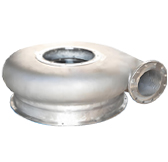 Overflow Volute
 Overflow Volute
 Underflow Volute
 Lower Housing
 Feed Inlet
 Assembly
 Casing
 Port Plate
 Side Cover 1
 Side Cover 2
 Side Cover 3
 Oil-free screw vacuum pump body
 50 cylinders
 Air-cooled cylinder block
 Cylinder head
 Assembly 2
 Assembly 3
 Acylinder
 Stirring paddle
 Stirring paddle2
 Kneading paddle (eccentric)
 Kneading paddle (center)
 Other castings
 Other castings


 About Us
 Corporate History
 Glimpse of the company
 Management
 News Center

 Environmental Sustainability
 Social Responsibility
 CN

