Double Suction Impeller Casting
At the core of large-scale water pumps, fans and other fluid conveying equipment, there is a vital component that is like the heart of the equipment, determining the performance, efficiency and stability of the entire system. This component is the double-suction impeller casting. As a core component formed through precision casting technology, the double-suction impeller plays an irreplaceable role in the industrial field with its unique structural design and excellent performance.

Manufacturing Process: The Art of Precision Casting
The quality of
double-suction impeller castings directly determines the performance of the final product. Its manufacturing process mainly includes the following key links:
1. Design and Mold Fabrication: Based on the hydraulic model and performance requirements, we use CAD/CAE software to conduct 3D design, flow field analysis, and structural stress simulation to ensure the scientific and reliable design. Precision casting molds are then fabricated based on the 3D model.
2. Casting: This is the core molding process. Depending on the impeller material (such as stainless steel, cast iron, bronze, etc.), an appropriate casting process is selected, such as investment casting or sand casting. Precision casting achieves higher dimensional accuracy and smoother surface quality, reducing subsequent processing.
3. Sand Cleaning and Heat Treatment: After the casting is formed, the molding sand and pouring riser need to be removed, and necessary heat treatment (such as annealing, normalizing, quenching, etc.) needs to be carried out to eliminate casting internal stress, refine the grain size, and improve the mechanical properties of the material, such as hardness, strength and toughness.
4. Machining: This is a key step to ensure the accuracy of impeller assembly. It mainly includes:
● Turning: Processing key assembly parts such as the impeller hub hole and end face to ensure precise fit with the pump shaft.
● Dynamic Balancing: The impeller is subjected to a high-speed rotation test on a dynamic balancing machine. By adding or removing mass at specific locations (such as drilling holes or welding counterweights), the residual imbalance is brought to the strictest international standards (such as ISO1940 G6.3 or higher). This is the lifeline for ensuring smooth, low-vibration operation of the pump unit.
5. Quality Inspection and Surface Treatment: Dimensional inspection and non-destructive testing (such as ultrasonic or radiographic testing) are performed to ensure that the castings are free of internal defects. Surface coating or anti-corrosion treatment is also performed as necessary to cope with different working media and environments.
Double suction impeller castings are a perfect example of the integration of technology and craftsmanship in the modern fluid machinery industry. With its unique symmetrical structure, it achieves the unity of strength and balance, and the balance of efficiency and stability. From meticulous hydraulic design to rigorous casting and finishing, every step embodies the wisdom of engineers and the skill of craftsmen. With the continuous advancement of materials science and manufacturing technology, double-suction impeller castings will continue to develop towards higher efficiency, longer life, and a wider range of applications.
 Double suction impeller
 Guide vanes
 Pump cover
 Split pump casing
 Volute
 Multistage pump
 Valve body
 Rotary plate valve
 Svalve disc plate
 Valve cover
 Cut off valve body
 Ball valve body
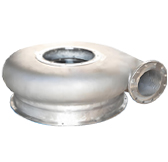 Overflow Volute
 Overflow Volute
 Underflow Volute
 Lower Housing
 Feed Inlet
 Assembly
 Casing
 Port Plate
 Side Cover 1
 Side Cover 2
 Side Cover 3
 Oil-free screw vacuum pump body
 50 cylinders
 Air-cooled cylinder block
 Cylinder head
 Assembly 2
 Assembly 3
 Acylinder
 Stirring paddle
 Stirring paddle2
 Kneading paddle (eccentric)
 Kneading paddle (center)
 Other castings
 Other castings


 About Us
 Corporate History
 Glimpse of the company
 Management
 News Center

 Environmental Sustainability
 Social Responsibility
 CN

