
In industrial mixing and kneading systems, the geometry of the paddle directly affects how materials are folded, sheared, and transferred inside the chamber. Among the available paddle designs, the
kneading paddle (eccentric) is widely used for demanding processing tasks because its offset structure helps improve material circulation and mixing uniformity. As a precision casting component, it also requires stable dimensions, smooth surfaces, and reliable mechanical performance.
What Is a Kneading Paddle (Eccentric)?
A kneading paddle (eccentric) is a specially shaped mixing part designed with an offset or non-centered working profile. Compared with conventional centered paddles, the eccentric layout changes the movement path of the material and creates a more active kneading effect during operation. This makes it especially suitable for processes that require stronger material turnover, better dispersion, and consistent mixing results.

Why the Eccentric Design Matters
The main value of the eccentric structure lies in the way it improves material flow inside the mixer. Instead of simply pushing material along a fixed path, the eccentric paddle helps create repeated folding and reorientation. In practical use, this can support:
1. Better material distribution across the mixing zone.
2. More efficient kneading action for viscous or hard-to-mix materials.
3. Reduced dead zones inside the chamber.
4. More stable process performance during continuous operation.
For manufacturers, these benefits translate into more reliable processing and more consistent final product quality.
Precision Casting Requirements for This Component
Because the kneading paddle works under repeated mechanical load, its casting quality has a direct impact on service life and operating stability. High-quality production should focus on the following points:
Dimensional accuracy: The paddle must match the assembly requirements of the mixer or kneader.
Surface finish: A smooth surface helps reduce material adhesion and improves cleaning efficiency.
Structural integrity: The casting must be free from defects that could weaken the part under load.
Wear resistance: The working surface should maintain performance during long-term use.
Balance and consistency: Uniform shape helps ensure stable rotation and controlled operation.

How the Casting Process Supports Performance
For parts like the kneading paddle (eccentric), precision casting is often a practical choice because it can reproduce complex shapes with good repeatability. Compared with basic machining from solid stock, casting offers several advantages:
It helps form the offset geometry more efficiently, reduces excess material waste, and makes it easier to achieve a clean, compact structure. After casting, additional finishing steps such as machining, grinding, and inspection can bring the component to the required assembly standard.
In other words, the casting process does not only shape the part; it also helps support the balance between manufacturing efficiency and final performance.
Typical Application Scenarios
The kneading paddle (eccentric) is commonly used in equipment where mixing quality is critical. Typical application scenarios include:
Mixing systems for industrial materials
Processes requiring strong kneading and folding action
Production lines handling viscous, dense, or difficult-to-disperse materials
Equipment that demands stable long-term operation and easy maintenance
Because operating conditions vary from one plant to another, the exact geometry, material grade, and finishing standard should always be selected according to the customer’s process requirements.
Quality Control Is Essential
For a component like this, quality control should cover the full production route, from pattern preparation and casting to finishing and final inspection. Visual inspection, dimensional checking, and performance-related verification all help ensure the part meets the intended use condition. A stable quality system is especially important for components that work in repeated motion and continuous-duty environments.

Conclusion
The kneading paddle (eccentric) is a compact but highly important casting component in mixing equipment. Its eccentric structure improves material movement, its precision casting process supports stable performance, and its surface and dimensional quality directly influence the efficiency of the whole system. For manufacturers seeking dependable blender castings, this part represents a strong balance of structure, function, and durability.
With careful design, accurate casting, and strict inspection, the kneading paddle (eccentric) can deliver reliable performance across demanding industrial applications.
 Double suction impeller
 Guide vanes
 Pump cover
 Split pump casing
 Volute
 Multistage pump
 Valve body
 Rotary plate valve
 Svalve disc plate
 Valve cover
 Cut off valve body
 Ball valve body
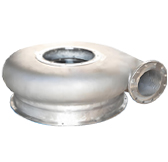 Overflow Volute
 Overflow Volute
 Underflow Volute
 Lower Housing
 Feed Inlet
 Assembly
 Casing
 Port Plate
 Side Cover 1
 Side Cover 2
 Side Cover 3
 Oil-free screw vacuum pump body
 50 cylinders
 Air-cooled cylinder block
 Cylinder head
 Assembly 2
 Assembly 3
 Acylinder
 Stirring paddle
 Stirring paddle2
 Kneading paddle (eccentric)
 Kneading paddle (center)
 Other castings
 Other castings


 About Us
 Corporate History
 Glimpse of the company
 Management
 News Center

 Environmental Sustainability
 Social Responsibility
 CN

