With the continuous improvement of downstream application fields’ requirements for centrifugal separation efficiency, reliability and environmental protection,
centrifuge castings are developing rapidly towards large-scale, lightweight, high-end materials and green production processes.
The advancement of industrial technology continues to pose new challenges to centrifuges and their core castings. Future development trends are mainly reflected in the following aspects:
1. Material Innovation and High-end Development:
In order to cope with more severe corrosive environments (such as deep sea and chemical industry), the application of corrosion-resistant materials such as high-performance duplex stainless steel, Hastelloy alloy, and titanium alloy will become more and more common.
In scenarios where wear resistance is required (such as mining and coal chemical industry), wear-resistant alloys such as high-chromium cast iron will be made into composite rollers through centrifugal casting to achieve a combination of strong matrix and wear-resistant surface.

2. Large-scale and Lightweight Structure:
In fields such as nuclear power and shipbuilding, the increase in separation processing volume requires the centrifuge drum diameter and capacity to continue to increase, which places extremely high demands on the casting capacity and quality control of large castings.
At the same time, through structural optimization design (such as bionic rib design) and the use of high-strength lightweight materials, light weighting is achieved while ensuring strength, thereby reducing start-stop energy consumption and inertia load.
3. Digital and Intelligent Manufacturing:
“Casting simulation + intelligent sensing + big data” will become standard. By collecting real-time data such as temperature and rotational speed during the casting process and comparing it with simulation predictions, closed-loop feedback and adaptive optimization of the process will be achieved, minimizing fluctuations caused by human factors and improving product consistency.
4. Green Manufacturing and Sustainable Development:
The process characteristics of
centrifugal casting itself have a high material utilization rate, which is in line with the concept of green manufacturing. Future trends will further focus on:
● Improvements in waste sand recycling and reuse technologies.
● Popularization of energy-saving smelting equipment (such as medium-frequency electric furnaces).
● Development of more environmentally friendly mold coatings and binders.
● Recycling of foundry waste and waste sand to reduce environmental impact.
The manufacturing technology of centrifuge castings is no longer a single “craft” but a comprehensive discipline that integrates materials science, fluid mechanics, thermodynamics, and intelligent control technology. Only by keeping pace with the trend of high-end, intelligent, and green manufacturing can manufacturers maintain a leading position in future market competition.
 Double suction impeller
 Guide vanes
 Pump cover
 Split pump casing
 Volute
 Multistage pump
 Valve body
 Rotary plate valve
 Svalve disc plate
 Valve cover
 Cut off valve body
 Ball valve body
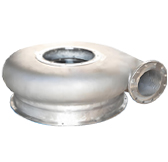 Overflow Volute
 Overflow Volute
 Underflow Volute
 Lower Housing
 Feed Inlet
 Assembly
 Casing
 Port Plate
 Side Cover 1
 Side Cover 2
 Side Cover 3
 Oil-free screw vacuum pump body
 50 cylinders
 Air-cooled cylinder block
 Cylinder head
 Assembly 2
 Assembly 3
 Acylinder
 Stirring paddle
 Stirring paddle2
 Kneading paddle (eccentric)
 Kneading paddle (center)
 Other castings
 Other castings


 About Us
 Corporate History
 Glimpse of the company
 Management
 News Center

 Environmental Sustainability
 Social Responsibility
 CN

