Stainless steel castings are widely used in pumps, valves, industrial equipment, and other applications where corrosion resistance and long service life are important. Their ability to resist corrosion mainly comes from their chemical composition, especially chromium, nickel, and molybdenum.
Understanding how stainless steel resists corrosion can help manufacturers select the right casting material for different working environments.

How Does Chromium in Stainless Steel Enhance Corrosion Resistance?
Stainless steel exhibits remarkable corrosion resistance, largely due to the presence of chromium. When the surface of stainless steel comes into contact with oxygen, chromium forms an extremely thin, chromium-rich oxide protective film, commonly referred to as a passive film.
This protective layer effectively minimizes the erosion of the underlying metal by moisture, oxygen, and other corrosive media. Under appropriate conditions, even if the surface suffers minor scratches, the passive film is capable of regenerating.
Consequently, chromium content and surface condition are critical factors influencing the corrosion resistance of stainless steel. Nevertheless, this passive film does not remain stable in all environments; for instance, high concentrations of chloride ions may induce localized corrosion.
What Roles Do Nickel and Molybdenum Play in Corrosion Resistance?
In addition to chromium, alloying elements such as nickel and molybdenum also significantly affect the performance of stainless steel castings.
▪ Chromium (Cr): Assists in the formation of the passive film, serving as a vital foundation for the corrosion resistance of stainless steel.
▪ Nickel (Ni): Helps stabilize the austenitic microstructure and improves the comprehensive performance of many austenitic stainless steels.
▪ Molybdenum (Mo): Enhances the material’s resistance to pitting and crevice corrosion, making it particularly applicable in service environments containing chloride ions.
The content and combination of various alloying elements will affect the behavior of castings in different media. Consequently, when selecting stainless steel castings, one should not merely rely on the material designation, but must evaluate them in conjunction with specific chemical compositions and service conditions.
Choosing the Right Stainless Steel Casting Grade
Different stainless steel grades offer different levels of corrosion resistance. Two commonly used casting grades are CF8 and CF8M.
CF8 stainless steel casting is commonly used for general industrial applications where good corrosion resistance is required. It is the cast equivalent commonly associated with wrought 304 stainless steel.
CF8M stainless steel casting contains molybdenum and is commonly associated with wrought 316 stainless steel. It generally offers better resistance to chloride-related pitting and crevice corrosion than CF8.
For pump bodies, valve bodies, impellers, and other industrial components, material selection should consider the fluid composition, chloride concentration, temperature, and operating pressure.
How to Maintain Corrosion Resistance in Stainless Steel Castings
Although stainless steel offers good corrosion resistance, it is not completely rust-proof. High chloride concentrations, unsuitable chemicals, elevated temperatures, and deposits on the surface can increase the risk of corrosion.
To improve service life, manufacturers and end users should:
▪ Select a suitable stainless steel grade for the working environment.
▪ Ensure proper casting quality and appropriate surface finishing.
▪ Remove contaminants and deposits from exposed surfaces.
▪ Use suitable cleaning and passivation procedures when required.
▪ Inspect components regularly, especially when they operate in corrosive fluids.
Proper material selection, manufacturing control, and maintenance work together to improve the reliability of stainless steel castings.
Conclusion
Stainless steel castings resist corrosion primarily through a chromium-rich passive layer, while elements such as nickel and molybdenum contribute additional benefits. However, corrosion resistance depends on both material composition and service conditions.
For industrial applications, selecting the appropriate casting grade and maintaining good surface condition are essential for achieving reliable performance and a longer service life.
FAQ
Q1: Why does stainless steel resist corrosion?
A: Stainless steel contains chromium, which forms a thin passive oxide layer on the surface. This layer protects the underlying metal from further corrosion under suitable conditions.
Q2: Do stainless steel castings rust?
A: Yes. Stainless steel castings can rust or corrode when exposed to aggressive chemicals, high chloride concentrations, surface contamination, or unsuitable operating conditions.
Q3: What is the difference between CF8 and CF8M stainless steel castings?
A: CF8 is commonly associated with 304 stainless steel, while CF8M is commonly associated with 316 stainless steel and contains molybdenum. CF8M generally provides better resistance to pitting and crevice corrosion in chloride-containing environments.
Q4: Which stainless steel casting grade is better for corrosive environments?
A: The appropriate grade depends on the specific environment. CF8 may be suitable for many general industrial applications, while CF8M may be preferred for certain chloride-containing fluids. More aggressive conditions may require higher-alloy materials.
Q5: How can the corrosion resistance of stainless steel castings be improved?
A: Choose the correct material grade, control casting quality, use appropriate surface finishing and passivation when needed, and prevent corrosive deposits from accumulating during service.
 Double suction impeller
 Guide vanes
 Pump cover
 Split pump casing
 Volute
 Multistage pump
 Valve body
 Rotary plate valve
 Svalve disc plate
 Valve cover
 Cut off valve body
 Ball valve body
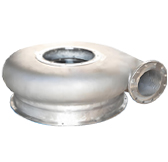 Overflow Volute
 Overflow Volute
 Underflow Volute
 Lower Housing
 Feed Inlet
 Assembly
 Casing
 Port Plate
 Side Cover 1
 Side Cover 2
 Side Cover 3
 Oil-free screw vacuum pump body
 50 cylinders
 Air-cooled cylinder block
 Cylinder head
 Assembly 2
 Assembly 3
 Acylinder
 Stirring paddle
 Stirring paddle2
 Kneading paddle (eccentric)
 Kneading paddle (center)
 Other castings
 Other castings


 About Us
 Corporate History
 Glimpse of the company
 Management
 News Center

 Environmental Sustainability
 Social Responsibility
 CN

