
Most sourcing projects start the same way. Three quotes arrive, one comes in 20 percent lower, and that one gets the order. Eighteen months later the valve bodies are pitting in a seawater line and nobody can produce a heat number.
Choosing a
stainless steel foundry has less to do with the number on the quote than with what you can verify afterwards. Below is the checklist we hand to customers who ask how to judge any supplier.
Match the Process to the Part Before Talking Price
Stainless castings come out of three main routes, and a factory that is excellent at one is often mediocre at the others.
- ▪ Sand casting handles heavy sections: pump housings, large valve bodies, centrifuge bowls. Tooling is cheap, a 300 kg part is routine, tolerances are looser.
- ▪ Investment casting, including the medium and low temperature wax route, is the answer for thin walls, complex internal passages and near-net shapes. You machine less and scrap less.
- ▪ Centrifugal and shell methods cover specific niches: rings, bushings, pipe sections.
Ask what share of the floor is devoted to each. If you need a 400 kg duplex pump casing and their largest flask is 600 mm, the price is beside the point.
Make Them Show the Chemistry
Material substitution is the most common failure in this industry. A 304 casting sold as 316L looks identical, machines identically, and corrodes years earlier than it should.
Four controls actually catch it:
- – A spectrometer on site, not a certificate photocopied from the scrap supplier.
- – A heat number stamped or tagged on every casting, traceable back to the melt.
- – Positive material identification on finished parts, when the order justifies it.
- – Mill test reports to EN 10204 3.1 tied to those heat numbers, not to a generic grade.
Any hesitation on those four and you have your answer.
Heat Treatment is Where Corrosion Resistance is Decided
As-cast stainless is not finished stainless. Both 316L and duplex 2205 need solution annealing inside a defined temperature window, held long enough and cooled fast enough. Run it short and the part passes a tensile test, then fails in service.
Two questions settle it. What is the furnace calibration record, and can you see the chart from the batch your parts actually came from? A foundry running proper heat treatment has both on file, without notice.

Capacity Fit, and Whether Machining is in the Same Building
A 2,000 tonne per year works and a 200 tonne job shop are different animals. Neither is better, they suit different orders. Ask for the monthly tonnage reserved for export work, not the nameplate capacity of the plant.
Machining matters more than buyers expect. When casting and machining sit in two different factories, the arguments over stock allowance, datum faces and who pays for a casting that cracks on the third operation will eat whatever saving you thought you had found.
Read Past the Certificate Logo
ISO 9001 is the floor, not the ceiling. What separates suppliers is which product standards they actually work to: ASTM A351 and A743 for valves and pumps, EN 10204 and EN 10213 for pressure purposes, PED for the European market, NACE MR0175 once sour service is involved.
ISO 14001 and ISO 45001 are worth a question too. They are not quality certificates, but plants holding them tend to get through environmental audits without stopping production mid order. In this industry that is not a theoretical risk.
Judge Them on the Awkward Question
Here is a reliable test. Tell a supplier a previous batch failed and ask what they would do. The strong answer mentions containment, a root cause report inside a stated number of days, and who pays freight. The weak answer is silence, or a long explanation of why it was your fault.
Response time at quotation stage is a decent proxy as well. If your drawing comes back with questions about wall transitions, radii and machining allowance before any price appears, someone technical has read it.
The short version
- ▪ Confirm the process fits the weight, wall thickness and tolerance of your part.
- ▪ Ask for spectrometer capability and heat number traceability.
- ▪ Request heat treatment records for your batch, not a sample certificate from last year.
- ▪ Confirm which NDT is inside the unit price.
- ▪ Match their monthly export tonnage against your annual volume.
- ▪ Prefer casting and machining under one roof.
- ▪ Check product standards, ASTM, EN, PED, not just ISO 9001.
- ▪ Get the non conformance process in writing before the first order.
Why Pump and Valve Buyers Work with Feilang Casting?
We are a family owned foundry in Zhangjiagang, Jiangsu, running continuously since 1985, which makes us one of the older privately held casting works in China. Our first export order came from NIKKISO in Japan in 1998, and that partnership is still active.
- √ Sand casting and medium to low temperature wax investment casting, in the same works.
- √ Austenitic stainless, duplex stainless, low temperature steel and carbon steel, plus nickel and cobalt based alloys.
- √ Valve bodies, bonnets, discs and brackets; pump casings, covers and impellers; centrifuge bowls; compressor and vacuum pump parts; marine and blender hardware.
- √ Around 90 engineers and technicians, most of them on the shop floor rather than in an office.
- √ ISO 9001:2015, ISO 14001:2015, ISO 45001:2018 and PED certification, plus Jiangsu Provincial High-Tech Enterprise status.
- √ Production to US, German and Japanese customer standards, shipping to more than ten countries.

Frequently Asked Questions
Should I use sand casting or investment casting for my part?
Start with weight, wall thickness and tolerance. Sand casting suits heavier sections, pump casings and large valve bodies where tolerances are generous and tooling cost needs to stay low. Investment casting suits thin walls, complex internal passages and near-net shapes, where you machine less and hold tighter dimensions. Under about 20 kg with tight tolerances, investment casting usually wins. Above that, or with thick sections, sand casting is generally the more economical route.
What is the real difference between 304 and 316 stainless castings?
316 carries roughly 2 to 3 percent molybdenum, and that is what buys resistance to chloride pitting. In casting grades it shows up as CF8 versus CF8M, or the low carbon CF3 versus CF3M. Seawater, brine, de-icing salt or any chloride bearing process water points to 316 or 316L. Fresh water, steam and mildly corrosive service are usually fine on 304 at lower cost. A foundry worth working with will ask about chloride content and operating temperature before quoting either.
 Double suction impeller
 Guide vanes
 Pump cover
 Split pump casing
 Volute
 Multistage pump
 Valve body
 Rotary plate valve
 Svalve disc plate
 Valve cover
 Cut off valve body
 Ball valve body
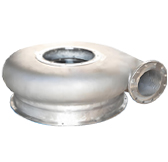 Overflow Volute
 Overflow Volute
 Underflow Volute
 Lower Housing
 Feed Inlet
 Assembly
 Casing
 Port Plate
 Side Cover 1
 Side Cover 2
 Side Cover 3
 Oil-free screw vacuum pump body
 50 cylinders
 Air-cooled cylinder block
 Cylinder head
 Assembly 2
 Assembly 3
 Acylinder
 Stirring paddle
 Stirring paddle2
 Kneading paddle (eccentric)
 Kneading paddle (center)
 Other castings
 Other castings


 About Us
 Corporate History
 Glimpse of the company
 Management
 News Center

 Environmental Sustainability
 Social Responsibility
 CN

