In modern fluid handling systems, the performance of a pump depends not only on the impeller, shaft, motor, and sealing system, but also on the structural integrity and dimensional accuracy of the pump casing components. As one of the important structural components in a pump assembly, the pump cover plays a critical role in maintaining the internal flow passage, supporting the overall casing structure, coordinating with sealing components, and ensuring stable operation under demanding working conditions.
For industrial applications involving water treatment, chemical processing, marine engineering, energy facilities, general industrial fluid transfer, and other demanding environments, stainless steel pump cover castings are widely selected because of their combination of corrosion resistance, mechanical strength, structural adaptability, and long-term service capability.

What Is a Pump Cover Casting?
A pump cover is a structural component installed as part of the pump casing assembly. Depending on the pump design, it may work together with the casing, impeller chamber, shaft sealing arrangement, bearings, mechanical seals, or other supporting components.
The exact geometry of a pump cover varies according to the pump type and operating requirements. Some designs contain complex internal cavities, mounting interfaces, bolt holes, sealing surfaces, ribs, flanges, and curved flow-related structures. These features can make the component difficult to manufacture through conventional machining alone.
Pump cover casting technology provides an efficient solution for manufacturing such complex metal components. By forming the basic geometry during the casting process, manufacturers can reduce the amount of material that needs to be removed during machining while maintaining the structural requirements of the finished part.
For stainless steel pump cover casting, the casting process must be designed according to the component’s geometry, wall thickness, material grade, required mechanical properties, and dimensional tolerances. The objective is to achieve a sound casting with controlled shrinkage, minimized internal defects, and sufficient machining allowance.
Why Stainless Steel Is Suitable for Pump Covers
Material selection is one of the most important factors in pump component manufacturing. Pump covers may be exposed to water, seawater, chemicals, process liquids, suspended particles, temperature fluctuations, and pressure variations. Therefore, the material must be selected according to the actual operating environment.
Stainless steel is widely used for pump castings because alloying elements such as chromium can provide corrosion resistance through the formation of a passive oxide film. Depending on the selected grade, the addition of nickel, molybdenum, and other alloying elements can further influence corrosion resistance, mechanical properties, toughness, and temperature capability.
For industrial pump applications, material selection should be based on the medium being transported, temperature, pressure, flow conditions, required service life, and applicable standards. A stainless steel pump cover casting can therefore be customized according to specific project requirements rather than relying on a single universal material.
How to Select a Stainless Steel Pump Cover Casting Supplier
When sourcing
stainless steel pump cover castings, buyers should evaluate more than the quoted price. A reliable supplier should demonstrate capabilities in engineering support, material control, casting technology, machining, inspection, and quality management.
Important evaluation criteria include:
- Engineering Capability:The supplier should understand casting design, material selection, machining allowances, gating systems, and dimensional requirements.
- Material Control:Material composition should be controlled through reliable testing and traceable records.
- Casting Experience:Experience with pump castings and other fluid-handling components can help reduce manufacturing risks.
- Quality Inspection:The supplier should have appropriate inspection equipment and procedures for dimensional and material verification.
- Production Capacity:The production system should be capable of handling the required casting size, weight, quantity, and delivery schedule.
- International Experience:For global customers, experience with international standards and technical specifications can simplify communication and project execution.
Feilang states that it has focused on pump and valve casting for approximately 40 years, with a team of technicians, assistant engineers, and engineers. Its facilities cover approximately 25,000 square meters, and its stated annual casting capacity is 3,000 tons, with a maximum single-piece weight of up to 10 tons. The company also reports ISO 9001, ISO 14001, ISO 45001, and PED certifications.
Quality Control from Material to Finished Pump Cover
Quality control should not be treated as a final inspection step only. For a high-performance pump cover casting, quality assurance begins at the material stage and continues throughout the entire manufacturing process.
At the material stage, chemical composition is verified. During casting, process parameters and filling conditions are controlled. After casting, the component may undergo heat treatment and surface cleaning. During machining, critical dimensions are measured against engineering drawings.
Finally, dimensional inspection and other applicable testing methods are performed. The objective is to ensure that the finished Pump Cover Casting meets the specified requirements before shipment.
This process-oriented approach is particularly important for industrial customers because pump components may be integrated into larger equipment systems where failure can lead to production downtime, maintenance costs, or safety risks.
Conclusion
The
pump cover is an essential component in many industrial pump assemblies. Its structural design, material selection, casting quality, dimensional accuracy, and surface condition can all influence the reliability of the complete pumping system.
Stainless steel casting provides an effective manufacturing solution for pump covers that require corrosion resistance, mechanical strength, complex geometry, and long-term durability. By combining appropriate casting technology with controlled heat treatment, precision machining, and comprehensive inspection, manufacturers can provide pump cover castings that meet demanding industrial requirements.
The selection of a suitable manufacturing process is equally important. Stainless steel sand casting can provide an economical solution for larger components, while investment casting offers advantages for smaller and more complex parts requiring higher dimensional accuracy and surface quality.
 Double suction impeller
 Guide vanes
 Pump cover
 Split pump casing
 Volute
 Multistage pump
 Valve body
 Rotary plate valve
 Svalve disc plate
 Valve cover
 Cut off valve body
 Ball valve body
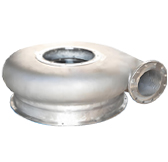 Overflow Volute
 Overflow Volute
 Underflow Volute
 Lower Housing
 Feed Inlet
 Assembly
 Casing
 Port Plate
 Side Cover 1
 Side Cover 2
 Side Cover 3
 Oil-free screw vacuum pump body
 50 cylinders
 Air-cooled cylinder block
 Cylinder head
 Assembly 2
 Assembly 3
 Acylinder
 Stirring paddle
 Stirring paddle2
 Kneading paddle (eccentric)
 Kneading paddle (center)
 Other castings
 Other castings


 About Us
 Corporate History
 Glimpse of the company
 Management
 News Center

 Environmental Sustainability
 Social Responsibility
 CN

