A
valve body is the main pressure-bearing shell of a valve. It defines the internal flow path, supports sealing interfaces, and carries the mechanical load created by fluid pressure, temperature changes, and repeated opening and closing cycles. In stainless steel casting, the valve body is not just a structural part; it is the foundation of flow safety, sealing reliability, and long service life.
At Feilang, the stainless steel casting range covers multiple valve-related parts, including valve bodies, valve covers, gate plates, brackets, ball valve bodies, and gate valve bodies. This product family shows that the company’s casting capability is built around practical industrial components rather than isolated single parts. The stainless steel casting center also presents the valve body.

Stainless Steel Valve Body in Industrial Systems
In industrial pipelines, the
valve body must do more than “hold” the valve internals. It must guide media smoothly, avoid excessive turbulence, maintain dimensional stability after casting, and provide enough machining allowance for sealing surfaces and threaded or flanged interfaces. A well-made valve body directly improves control accuracy and reduces leakage risk.
Stainless steel is an ideal material for this type of component because it combines corrosion resistance, mechanical strength, and adaptability to demanding service environments. That is why stainless steel castings are widely used in pumps, valves, centrifuges, vacuum pumps, compressors, and blenders across different sectors.
Casting Routes for Valve Body Manufacturing
Feilang states that it specializes in stainless steel sand casting and medium-to-low temperature wax precision casting. On the same stainless steel casting center, sand casting is described as suitable for large and cost-effective castings, while investment casting is used for small, high-precision, complex parts.
For a valve body, the choice of process depends on size, pressure rating, geometric complexity, and finishing requirements. If the body is relatively large and the project values robust economics, sand casting offers a practical route. If the internal shape is complex and the design requires tighter dimensional control and smoother surfaces, investment casting becomes the stronger option.
Why Precision Matters in a Valve Body
A valve body is a mating component. Its cavities, seats, flange faces, ports, and mounting interfaces must align precisely with the disc, ball, gate, cover, and actuator system. Even a small deviation can affect sealing performance, increase flow resistance, or force unnecessary rework during machining.
This is why dimensional accuracy, defect control, and repeatable casting quality are essential. A stable casting route helps keep the valve body consistent from batch to batch, which is especially important for OEM supply, spare parts replacement, and long-term industrial procurement.
Core Advantages of Stainless Steel Valve Body Casting
First, stainless steel provides corrosion resistance for water, steam, chemical fluids, and other aggressive media. Second, it offers the strength needed for pressure-bearing applications. Third, the casting process allows the body to be formed as an integrated structure, reducing unnecessary joints and improving mechanical integrity.
Compared with fabricated assemblies, a cast valve body usually delivers a cleaner structural layout and more efficient material usage. Compared with low-precision forming methods, precision casting better supports compact internal passages and a more reliable finished shape.
From Raw Material to Finished Valve Body
A reliable valve body casting begins with material control. The alloy composition must match the service requirement, because chromium, nickel, and related elements determine corrosion resistance and overall performance. After that, mold design, pouring control, solidification management, and post-cast inspection all influence whether the final part can meet real industrial expectations.
Feilang’s stainless steel casting center emphasizes two process directions: sand casting for large castings and investment casting for high-precision complex castings. That combination is important because valve body orders often vary widely in size, geometry, and working condition.
Quality Control for Valve Body Casting
Quality control is not an afterthought; it is part of the casting route itself. In Feilang’s related stainless steel casting content, the company highlights that stainless steel pump castings require inspection from the source, including raw material testing, surface inspection, dimensional testing, and internal defect detection. The same logic applies directly to valve body castings, which also rely on integrity, density, and dimensional stability.
For a valve body, the most important checkpoints usually include wall thickness uniformity, sealing face quality, machining allowance, porosity control, and internal soundness. If these points are under control, the body can support stable valve performance during prolonged service.
Typical Valve Body Applications
Stainless steel valve bodies are commonly used in water treatment, chemical processing, food-grade fluid systems, marine equipment, pump and pipeline networks, and general industrial flow control lines. The exact product series at Feilang also includes gate valves, globe valves, check valves, ball valves, butterfly valves, plug valves, and regulating valves, indicating a broad valve casting capability.
In these systems, the valve body is often the first line of defense against leakage and pressure instability. A strong casting base allows the rest of the valve assembly to work with higher reliability and lower maintenance demand.
Why Feilang’s Stainless Steel Casting Capacity Matters
Feilang states that its stainless steel castings include valve parts, pump parts, mechanical castings, marine parts, and hardware accessories, with an annual production capacity of 2000 tons. That scale matters because industrial buyers usually care about both engineering quality and supply continuity.
For valve body procurement, supply stability is as important as performance. When a manufacturer can maintain casting capability across multiple product categories, it usually signals a more mature process system, stronger coordination between design and production, and better support for custom projects.
Conclusion
A stainless steel
valve body is a compact but decisive component. It determines how a valve carries pressure, manages flow, and maintains sealing reliability over time. When precision casting is matched with the right material, the result is not just a metal part, but a dependable foundation for stable industrial operation.
Feilang’s stainless steel casting capability, its dual-route process strategy, and its broad valve product series provide a strong technical base for producing valve bodies that meet demanding industrial requirements. For projects that need durability, accuracy, and corrosion resistance in one component, stainless steel valve body casting remains a highly practical solution.
 Double suction impeller
 Guide vanes
 Pump cover
 Split pump casing
 Volute
 Multistage pump
 Valve body
 Rotary plate valve
 Svalve disc plate
 Valve cover
 Cut off valve body
 Ball valve body
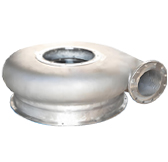 Overflow Volute
 Overflow Volute
 Underflow Volute
 Lower Housing
 Feed Inlet
 Assembly
 Casing
 Port Plate
 Side Cover 1
 Side Cover 2
 Side Cover 3
 Oil-free screw vacuum pump body
 50 cylinders
 Air-cooled cylinder block
 Cylinder head
 Assembly 2
 Assembly 3
 Acylinder
 Stirring paddle
 Stirring paddle2
 Kneading paddle (eccentric)
 Kneading paddle (center)
 Other castings
 Other castings


 About Us
 Corporate History
 Glimpse of the company
 Management
 News Center

 Environmental Sustainability
 Social Responsibility
 CN

