In centrifugal pump systems, the
volute is one of the most important flow-guiding components. It works as the spiral-shaped casing that collects liquid discharged from the impeller and gradually converts velocity into pressure. In Feilang’s stainless steel casting series,
Volute is positioned within the pump castings family together with double suction impeller, guide vanes, pump cover, split pump casing, and multistage pump components, showing that it is treated as a core functional part rather than a simple shell.

From a design perspective, the volute is not only a geometric enclosure. Its cross-sectional growth, scroll profile, and outlet alignment directly affect hydraulic efficiency, operating stability, vibration level, and noise behavior. In practical pump engineering, a well-cast volute supports smoother discharge, lower hydraulic loss, and more reliable long-term service. The meaning of “volute” itself also matches this function: major dictionaries describe it as a spiral or scroll-shaped form, and in machinery it refers to the spiral casing around an impeller pump.
Why Volute Matters in Stainless Steel Casting
A volute made through stainless steel casting is typically chosen for demanding fluid-handling environments. Stainless steel is widely valued for corrosion resistance, strength, heat resistance, formability, and recyclability, which makes it highly suitable for industrial components exposed to water, chemicals, process fluids, or abrasive working conditions. That material profile aligns closely with pump and valve castings where dimensional stability and surface integrity matter.
Feilang’s stainless steel casting page states that the company provides stainless steel castings and focuses on pump castings, including volute among its representative products. The same product ecosystem also covers valve castings, centrifuge castings, vacuum pump castings, compressor castings, and blender castings, which indicates a broad precision-casting capability across multiple industrial categories.
For buyers and engineers, this matters because a volute is only as good as the casting behind it. If the internal flow path has porosity, shrinkage, rough surfaces, or uneven wall thickness, the hydraulic performance can be compromised. A precise casting route helps reduce machining burden, preserve geometry, and improve consistency from batch to batch.
Quality Inspection and Stability
Feilang has a dedicated quality control presence on its site, and it also publishes a product-related article specifically about stainless steel pump casting inspection. That tells us the company does not treat inspection as a final afterthought; instead, quality control is part of the production logic. For a volute, this is essential because hidden defects inside the flow path can directly affect pump efficiency and reliability.
Quality inspection for a volute generally includes dimensional verification, visual examination, surface condition review, and internal integrity checks according to part criticality. In a precision-casting context, these checkpoints help ensure that the final part fits both hydraulic design intent and actual assembly requirements.
Feilang’s broader sustainability and manufacturing pages also show that the company emphasizes controlled production, factory capability, and long-term industrial responsibility. That kind of factory discipline is relevant to volute production because consistent casting outcomes depend on stable process management, not one-off adjustments.
Typical Application Scenarios
Volute castings are widely used in centrifugal pumps where fluid must be collected efficiently after leaving the impeller. In the Feilang product ecosystem, the volute sits alongside pump cover, split pump casing, multistage pump, and double suction impeller, indicating that it is intended for diverse pump architectures rather than a single niche model.
Common use cases include water supply, industrial circulation, process transfer, HVAC circulation, and other applications where stable discharge and corrosion resistance are important. Because stainless steel offers a strong balance of strength and corrosion resistance, it remains a preferred choice for demanding pump environments.
In replacement-part markets, volute castings must be especially reliable because they often need to match existing pump interfaces. A good casting vendor therefore has to balance geometry accuracy, repeatability, and practical machining support. Feilang’s product structure and process mix suggest that this type of demand is within its manufacturing scope.
How to Evaluate a Volute Supplier
When selecting a volute supplier, the first question is whether the manufacturer understands both the hydraulic role and the metallurgical demands of the part. A supplier that only “casts shape” without controlling internal quality may produce parts that look acceptable externally but fail in service.
The second question is process fit. For complex pump castings, the supplier should be able to explain whether sand casting, investment casting, or another route is being used, and why. Feilang’s site explicitly presents stainless steel sand casting and investment casting content, which is a useful signal that it can match process to part requirement.
The third question is inspection discipline. If the supplier has published quality control or inspection-related content, that usually indicates a stronger internal process culture. For volute parts, this matters because defects in the scroll cavity or outlet region are often hidden until the pump enters actual operation.
Feilang’s Volute Position in the Product System
Feilang’s product pages group volute with other pump castings such as double suction impeller, guide vanes, pump cover, split pump casing, and multistage pump. This clustering is important: it shows that the company views volute as part of a complete pump-casting system rather than an isolated commodity part.
The same product ecosystem also includes valve castings, centrifuge castings, vacuum pump castings, compressor castings, and blender castings, which reinforces Feilang’s identity as a precision stainless steel casting supplier for multiple industrial sectors.
This matters for sourcing because buyers often need not only a single volute, but also adjacent components in the same material family and tolerance logic. A supplier with a wider casting portfolio can more easily support system-level consistency.
Conclusion
A stainless steel
volute is a small word for a big job. It collects flow, shapes pressure recovery, and influences the real-world performance of a pump system. When it is produced by a supplier with clear process discipline, quality inspection, and a focused pump-casting portfolio, the result is not just a cast part, but a dependable hydraulic component. Feilang’s public product structure and process descriptions support exactly that kind of positioning.
 Double suction impeller
 Guide vanes
 Pump cover
 Split pump casing
 Volute
 Multistage pump
 Valve body
 Rotary plate valve
 Svalve disc plate
 Valve cover
 Cut off valve body
 Ball valve body
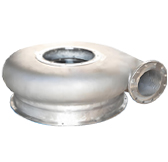 Overflow Volute
 Overflow Volute
 Underflow Volute
 Lower Housing
 Feed Inlet
 Assembly
 Casing
 Port Plate
 Side Cover 1
 Side Cover 2
 Side Cover 3
 Oil-free screw vacuum pump body
 50 cylinders
 Air-cooled cylinder block
 Cylinder head
 Assembly 2
 Assembly 3
 Acylinder
 Stirring paddle
 Stirring paddle2
 Kneading paddle (eccentric)
 Kneading paddle (center)
 Other castings
 Other castings


 About Us
 Corporate History
 Glimpse of the company
 Management
 News Center

 Environmental Sustainability
 Social Responsibility
 CN

